|
  |


|
100 Strange Creatures #005 MrLunk, October 7, 2008 at 11:01:41 PM CESTh
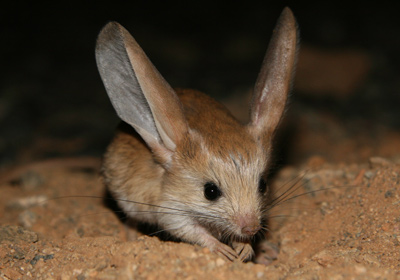 Jerboas are the bulk of the membership of the family Dipodidae; they are small jumping desert rodents of Asia and northern Africa that resemble mice with a long tufted tail and very long hind legs. The small forelegs are not used for locomotion. In general, Asiatic jerboas have five toes on their hind feet and African jerboas have three; the shapes of their ears vary widely between species. Jerboa fur is long, soft and silky. Diet varies considerably: some are specialist seed, insect, or plant eaters, others are omnivores. Jerboas obtain energy by eating plants. Video embed code:
Wikipedia links: ENG: Jerboa
... link 100 Strange Creatures #004 MrLunk, October 7, 2008 at 10:20:05 PM CESTh
The Frilled Shark, a species of shark rarely seen alive because its natural habitat is about 2,000 feet under the sea was captured on film by staff at a Japanese marine park this week.
 The Awashima Marine Park in Shizuoka, south of Tokyo, was alerted by a fisherman at a nearby port on Sunday that he had spotted an odd-looking eel-like creature with a mouthful of needle-sharp teeth. Marine park staff caught the 5 foot (1.6 meter) long creature, which they identified as a female frilled shark, sometimes referred to as a "living fossil" because it is a primitive species that has changed little since prehistoric times. The shark appeared to be in poor condition when park staff moved it to a seawater pool where they filmed it swimming and opening its jaws.
 "We believe moving pictures of a live specimen are extremely rare," said an official at the park. "They live between 1,968 and 3,280 feet (600 and 1,000 meters) under the water, which is deeper than humans can go." Video embed code:
"We think it may have come close to the surface because it was sick, or else it was weakened because it was in shallow waters," the official said. Wikipedia links:
... link 100 Strange Creatures #003 MrLunk, October 7, 2008 at 11:20:07 AM CESTh
Het zijn kleine, gesegmenteerde diertjes die leven in een vochtige omgeving. Ze komen overal op de wereld voor in zout of zoet water, maar ook in vochtige omgevingen op het land, bijvoorbeeld in mossen. Ze zijn te vinden op grote hoogte in de Himalayas (boven 6.000 m), tot in de diepzee (beneden 4.000 m) en van de polen tot aan de evenaar. De grootte varieert van minder dan 0,1 tot circa 1,5 mm. Kijk goed dan zie je dit unieke diertje wandelen. Video embed code:
Een opmerkelijke eigenschap van beerdiertjes is cryptobiose (schijndood): ze kunnen onder omstandigheden van langdurige droogte, koude of warmte overleven. Beerdiertjes die op mossen leven zijn eraan gewend, dat het mos soms volledig uitdroogt en kunnen overleven door te verschrompelen tot een soort zak-achtige vorm. Educatieve Website met meer filmpjes en fotos... Wikipedia links:
... link |
|
||||





|